
Lab-Grown vs. Natural Diamonds: A Guelph Jeweller's Honest Take
- Patrick Elrafih
- Jun 18
- 6 min read
Updated: Jun 24

When couples walk through the custom ring design process with me, one question comes up almost every time: "Should I choose a lab-grown diamond or a natural one?"
It's not a simple answer, and that's actually why I love this question. It forces us to dig deeper into what matters most to you, your budget, and what will make that ring feel truly yours.
I source both lab-grown and natural diamonds for my clients, and after years of curating stones for custom engagement rings, I've learned that there's no universally "right" choice. There's only the right choice for you. Let me break down what I've learned, so you can decide with confidence.
What Are Lab-Grown Diamonds?
Lab-grown diamonds (also called lab-created or cultured diamonds) are real diamonds made in a laboratory in just weeks or months, rather than formed deep in the earth over billions of years.
How they're made: Scientists use one of two methods to create them: High Pressure High Temperature (HPHT) or Chemical Vapor Deposition (CVD). Both start with a tiny diamond seed and layer carbon onto it until a full-size diamond crystal forms.
The result: A stone that is chemically, physically, and optically identical to a natural diamond. A gemologist with specialized equipment can tell them apart, but to the naked eye and in your hand, they look and feel exactly the same.
What Are Natural Diamonds?
Natural diamonds formed in the earth's mantle 1–3 billion years ago, survived geological upheaval, traveled to the surface through volcanic eruptions, and were then mined.
How they form: Carbon deep underground, exposed to intense heat and pressure, transforms into crystalline diamond. It's a process that takes an incomprehensible amount of time.
The result: A stone with a geological history. It's literally ancient, one-of-a-kind in its formation journey, and rare because there's only so much of it in the world.
The Honest Comparison
Here's where I break down the actual differences, because marketing speak on both sides can get pretty loud.
Durability & Longevity
Both are essentially identical. Lab-grown and natural diamonds score 10 on the Mohs hardness scale, the hardest natural substance on earth. Both will last forever if cared for properly. Neither one will deteriorate or become cloudy over time.
The real difference: None. Wear either with confidence.
Appearance & Brilliance
If you put a well-cut lab-grown diamond next to a well-cut natural diamond of the same specs, 99% of people couldn't tell them apart with the naked eye.
Both sparkle the same. Both have the same fire, brilliance, and light performance. The 4Cs (carat, colour, clarity, cut) apply equally to both.
What matters more: The quality of the cut. A beautifully cut lab-grown diamond will outshine a poorly cut natural diamond every single time. I prioritize the cut above all else when curating stones for custom rings.
Cost
Lab-grown diamonds are typically a fraction of the price of an equally graded natural diamond, often 40–60% less, sometimes even more.
A 1.5 carat natural diamond graded VS1 clarity and H color might cost $7,000–$9,000. The same specs in lab-grown? Expect $2,500–$3,000. That's genuinely significant savings.
Why the difference: Supply and demand. Natural diamonds are rare; lab-grown diamonds can be made on demand. Mining natural diamonds is expensive and complex; lab creation is a more streamlined process.
Real talk: If budget is a priority, lab-grown is a game-changer. You can either spend considerably less for the same specs, or invest that savings into a larger stone, higher clarity, or a more intricate setting design. For couples shopping in your price range ($5k–$10k), that difference can be the key to getting exactly what you want without stretching your budget. That's a tangible advantage.
Resale Value
This is where they differ meaningfully.
Natural diamonds hold resale value better. If you ever wanted to sell or trade in a natural diamond, you'd recover 50–70% of what you paid (depending on market conditions and the stone's specs).
Lab-grown diamonds, because they're newer to the market and can be produced infinitely, don't hold resale value as well. You might recover 20–40% if you tried to sell one. Some jewellers won't buy them back at all.
However: Most people don't buy engagement rings planning to resell them. If you're keeping it forever, resale value is largely irrelevant. But if there's any chance you might want to trade up, upgrade, or sell down the line, a natural diamond is the safer bet.
Environmental & Ethical Considerations
This is where people have strong opinions, and I want to be honest about both sides.
Lab-grown diamonds:
Require electricity to create (and how "clean" that electricity is depends on the lab's location and power source)
No mining required, so no land disruption
No human labor concerns in creation
Generally marketed as the "eco-friendly" option
Natural diamonds:
Require mining, which does disrupt land and ecosystems
Mining operations vary widely in their environmental and labor practices
Conflict diamonds (diamonds mined in war zones to fund armed conflict) are a real historical issue, though the Kimberley Process was created to address this
Many natural diamonds today come from responsibly managed mines with good labor practices
The nuance: Neither is perfect. Lab-grown isn't automatically "guilt-free." It depends on where it was made and what power grid it used. Natural diamonds aren't automatically "bad." Many come from ethical sources. If environmental and ethical sourcing matter deeply to you, ask questions about where your stone comes from, whether it's lab-grown or natural.
I source both from suppliers I trust, and I'm happy to discuss the origin story of any stone I curate for you.
Emotional Value & Sentiment
This is less tangible, but it's real.
Some couples feel a deep connection to the fact that their natural diamond is ancient. It's literally billions of years old, a piece of earth's history on their finger. There's something poetic about that.
Other couples love the idea of a lab-grown diamond. It's modern, it's guilt-free (in their mind), it's not a product of mining, and it's a more accessible price point. That matters emotionally too.
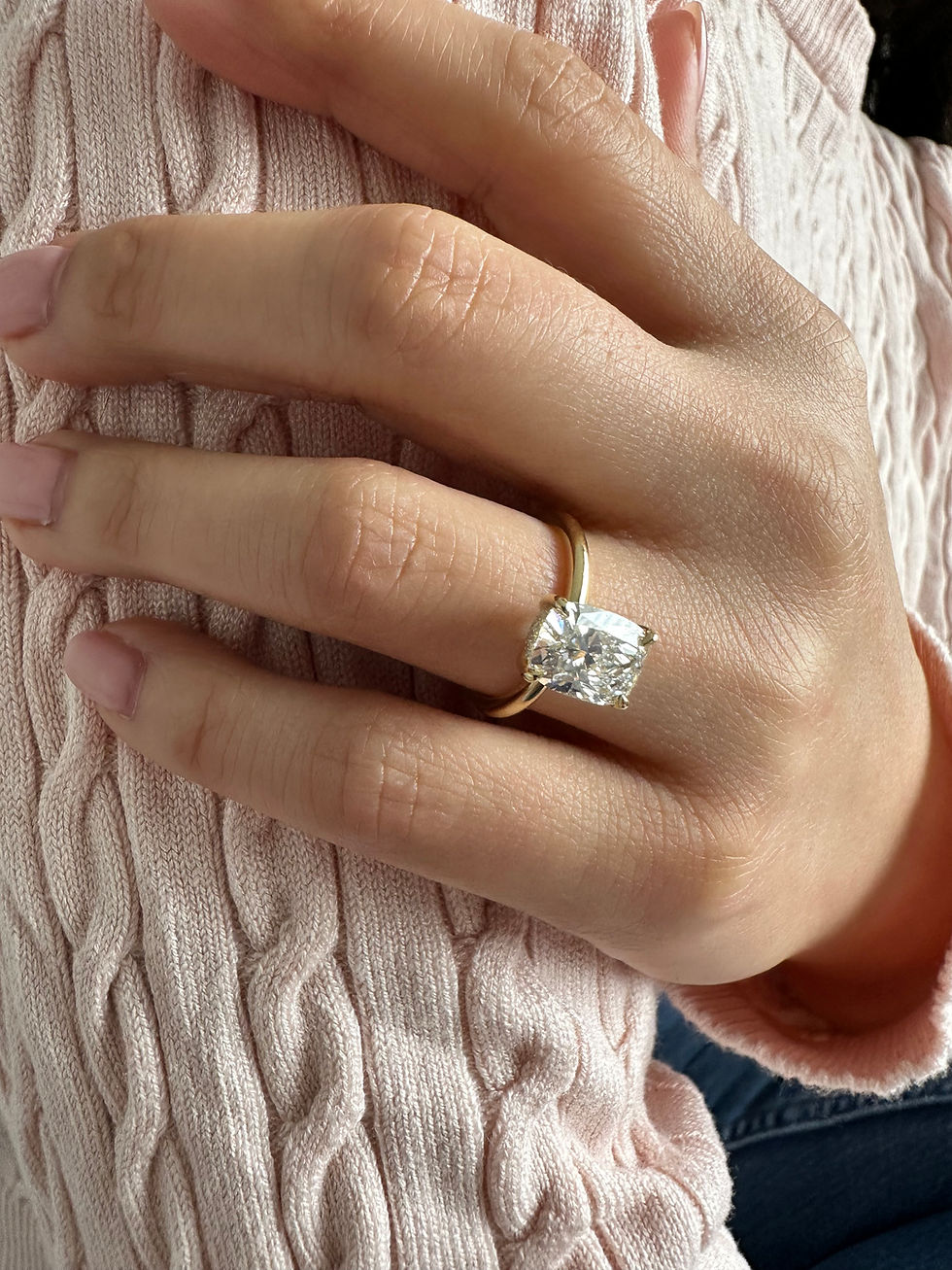
My take as a jeweler: The stone that makes you happiest when you look at your hand is the right stone. If you feel a flutter of emotion every time you catch the light on it, then you made the right choice, regardless of whether it was lab-grown or natural.
The Curator's Perspective
After hand-selecting hundreds of diamonds for custom rings, here's what I've learned:
Lab-grown diamonds are fantastic if:
Budget is a constraint and you want maximum size or clarity for your money
You want a larger stone than your budget would allow with natural diamonds
You prefer the story of modern innovation over ancient rarity
You want to prioritize spending more on the setting design rather than the center stone
Natural diamonds are wonderful if:
You want a stone with geological history and rarity
Resale value matters to you
You're drawn to the tradition and timelessness of a mined diamond
You want something that will always hold its value
The honest truth: I've designed stunning rings with both. I've had couples choose lab-grown and be absolutely thrilled. I've had couples choose natural and feel that deep emotional satisfaction. The difference isn't in the stone, it's in what aligns with your values and priorities.
How to Decide
If you're torn, ask yourself these questions:
What's my budget, and would a lab-grown diamond let me upgrade in size or quality? (If yes, that's a real practical advantage.)
Does the idea of an ancient, rare stone matter emotionally to me? (If yes, natural might be your answer.)
Could I see myself selling or trading this ring at some point? (If yes, natural holds value better.)
What story do I want to tell about my ring? (This is the most important one. Your answer matters more than any spec sheet.)
There's no wrong choice here. There's only the choice that's right for you.
Let's Design Your Ring
Whether you choose lab-grown or natural, the next step is the same: finding a stone that makes your heart skip when you see it, then designing a setting that showcases it perfectly.
I work with couples through the entire process, from stone selection to design to the moment you slip it on. My job is to help you navigate these decisions with confidence, not pressure.
Ready to start your custom ring journey? Book a free design consultation and let's find the perfect diamond for you.
Or if you have questions about lab-grown vs. natural before you're ready to book, get in touch. I'm here to help.


Comments